
Keynote 1: Decidability in the Age of AI: From Information to Meaningful Decisions
Speaker: Prof. Vlado Stankovski
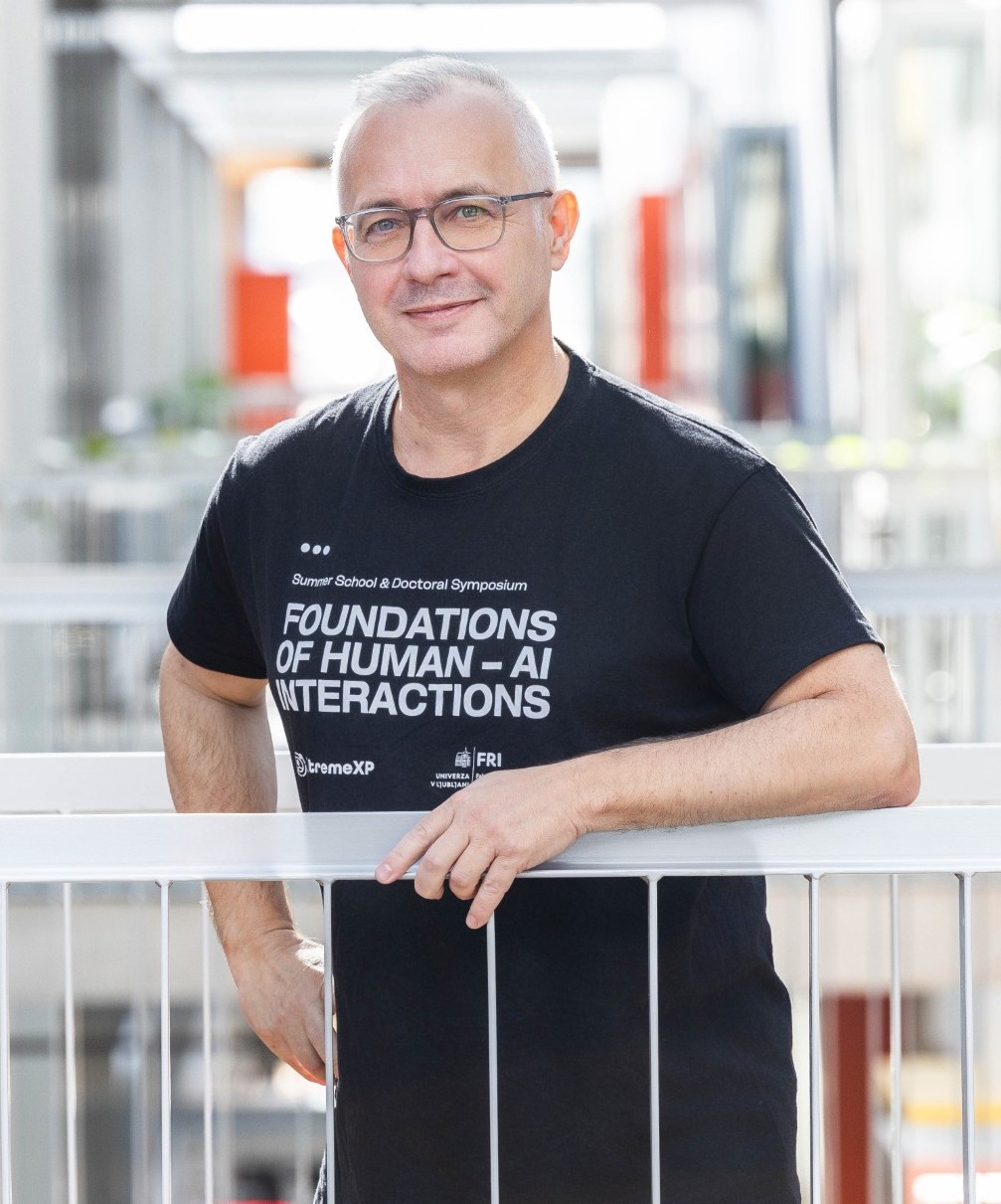
Abstract: As the Internet of Things (IoT) evolves towards intelligent autonomous systems, a fundamental question emerges: Can machines make decisions whose meaning, validity and consequences they can explain? The universal models of computation and their fundamental limits, established by Turing, Gödel and Rice, remain highly relevant in the age of generative AI. Producing plausible answers is not equivalent to establishing valid knowledge. Drawing on our recent research in scientific decision workflows, this keynote explores how semantic knowledge, contextual reasoning, probabilistic assurance and Markov Decision Processes enable decisions to be represented, ranked, verified and reused. Looking further ahead, we introduce Quantum Autopoiesis, a physically grounded, quantum-informational model of recursive identity and knowledge discovery. Its translation into computing suggests two fundamental innovations: (1) identity-preserving semantic states, representing evolving knowledge and meaningful decisions, and (2) stochastic evolutionary decision pathways, supporting the probabilistic accumulation, adaptation and reuse of knowledge. Fourteen scientific requirements provide a framework for systematically examining these principles against established computational paradigms, such as the universal computing model of Church and Turing. Together, these ideas address one of the deepest mysteries of the physical world we inhabit: how elementary interactions can give rise to persistent identity, meaningful decisions, cognition and cumulative knowledge. And, how understanding these processes might inspire a fundamentally new semantics-first approaches to computation.
Bio: Vlado Stankovski is a Professor of Computer and Information Science at the University of Ljubljana, Slovenia. His research spans software engineering, distributed systems, cloud–edge computing, semantic technologies, artificial intelligence and the foundations of computation. He served as scientific and technical coordinator of the European Next Generation Internet projects ONTOCHAIN and TRUSTCHAIN, supporting more than 100 technology development teams. His research portfolio includes ExtremeXP, Swarmchestrate, DECENTER, BUILDCHAIN, EBSI-VECTOR, ACES (Autopoietic Cloud-Edge System), ENTICE, SWITCH, ESSA, NOO ULTRA 4.03 and 8.05 (Microcredentials for Microcompetences) and IQ DOM. He also leads a Slovenia–China bilateral research project (2026–2028) on intelligent cloud orchestration and efficient scheduling for large-model inference. Recently, he has delivered keynote talks at the IEEE International Congress on AI for Science 2024 in Kaifeng, China, and the 7th International Conference on Blockchain Computing and Applications (BCCA 2025) in Dubrovnik, Croatia. He served on the Strategic Advisory Board of the European Commission’s Destination Earth initiative and contributed to the European Commission’s foresight study, The EU’s Critical Digital Capacities: Deployment Beyond 2027 (European Commission publication). His recent research focuses on scientific decision-making, trustworthy AI and Quantum Autopoiesis, exploring the physical foundations of recursive identity, computation, cognition and knowledge discovery.
Keynote 2: Where Should Intelligence Live? Rethinking IoT Architectures for AI and XR
Speaker: Prof. Jussi Kangasharju

Abstract: Where should computation and intelligence reside in an IoT system? Edge computing has been used to bring processing closer to devices and users. However, proximity alone is not a sufficient basis for architectural decisions. Application requirements, access networks, and the relative costs of computation, memory, storage, and communication all shape whether a deployment makes sense. Based on our past research into cloud connectivity and recent measurements of a collaborative XR classroom, this talk revisits the assumptions behind edge computing. Our XR deployment provides a concrete example of how remote connectivity, wireless access, device behavior, and shared-state synchronization contribute differently to system performance. Extending this example with AI raises further questions about model placement, inference quality, resource sharing, and the timing requirements of different functions. We then explore three architectural directions across a tradeoff spanning computation, storage, and communication. Changing memory costs lets us put this tradeoff in a new light. We conclude by identifying when each approach is viable and how systems might adapt as workloads, connectivity, and resource costs change.
Bio: Jussi Kangasharju is a Professor and the head of the department of Computer Science, at University of Helsinki, Helsinki, Finland. He received his MSc from Helsinki University of Technology in 1998. He received his Diplome d’Etudes Approfondies (DEA) from the Ecole Superieure des Sciences Informatiques (ESSI) in Sophia Antipolis in 1998. In 2002 he received his PhD from University of Nice Sophia Antipolis/Institut Eurecom. In 2002 he joined Darmstadt University of Technology (TUD), first as post-doctoral researcher, and from 2004 onwards as assistant professor. Since June 2007 Jussi is a professor at the department of computer science at University of Helsinki and from 2022 onwards he is the head of the department. Between 2009 and 2012 he was the director of the Future Internet research program at Helsinki Institute for Information Technology (HIIT). Jussi’s research interests are information-centric networks, edge and cloud computing, content distribution, opportunistic networks, and green ICT. He is a member of IEEE and ACM.
Keynote 3: The Road to Agentic Edge AI: From Small Models to Autonomous Systems
Speaker: Prof. Blesson Varghese

Abstract: Edge AI has traditionally focused on executing predefined tasks on resource-constrained devices. Advances in model compression, efficient inference, and adaptive execution have made increasingly sophisticated AI capabilities accessible at the edge. However, efficiently executing AI models is only the foundation for the next frontier – autonomous systems capable of reasoning, planning, and acting towards high-level goals. In this keynote, I trace the road to Agentic Edge AI, drawing on our research in neural network pruning, small language models, adaptive LLM execution, and agentic systems. I will explore the transition from optimising individual models and predefined tasks to building goal-driven systems that can autonomously synthesise, execute, and refine workflows across the computing continuum. Finally, I will highlight emerging empirical insights into the capabilities and limitations of local and hybrid agentic systems, and reflect on some of the open research challenges in making autonomous edge intelligence practical, efficient, and dependable.
Bio: Blesson Varghese is a Professor of Computer Science at the University of St Andrews. His research focuses on large-scale distributed systems spanning the cloud and edge, with a particular interest in resource-efficient Edge AI. His career combines academic, industry, and consulting experience across multiple continents. He directs the Edge Computing Hub, funded by Rakuten Mobile Inc., Japan, and co-leads research on Edge Computing for AI within the UK’s National Edge AI Hub (https://edgeaihub.co.uk), a national initiative involving 15 universities and over 75 industry and public-sector organisations. He previously held a Royal Society Short Industry Fellowship with British Telecommunications plc and received the 2021 IEEE Rising Star Award from the Technical Committee on the Internet for fundamental contributions to edge computing systems and applications. He has featured in Clouded, a documentary on cloud computing produced by Hewlett Packard and VMware, has been interviewed by broadcasters including ABC and CBC, and has provided expert commentary to Fortune magazine.